


Get in touch!
We don't provide our services to anyone else, and we are always available to help when you need us. To contact us, please fill out the following form.

At Orthotics.co.uk, we provide independent, clinician-led orthotic services and are not a manufacturer.
This independence allows us to select the most appropriate drop foot splint from the full range of specialist manufacturers, rather than being limited to a single in-house system or production skillset. We are not tied to any one supplier and do not receive commission or incentives from brace or splint manufacturers.
As a result, we can consider all suitable options available and recommend the drop foot solution most likely to deliver the best outcome based on each patient’s clinical needs, lifestyle, and goals.
This means we are well placed to answer the question most people with drop foot ask: “What is the best splint to help with my drop foot?”
If only it were that simple. Unfortunately, there isn’t one drop foot splint that is “the best” for everyone.
The most suitable drop foot splint depends on a range of individual factors, including:
It is fair to say that all drop foot splints have pros and cons and that no drop foot splint is suitable for every occasion. Below, we have compiled a helpful list of some of the most effective splint types we use in our clinics to help manage drop foot in our patients. In no particular order:
The Turbomed Xtern is a lightweight, external ankle foot orthosis that attaches to the outside of the shoe rather than fitting inside. It provides a high level of dynamic dorsiflexion assistance to help lift the foot during walking, and feedback from our patients suggests it is one of the most comfortable options for managing drop foot.
Key pros / limitations to the Turbomed Xtern?
Pros:
✅Comfortable.
✅Lightweight.
✅Durable.
✅Does not take up space inside the shoe, can be transferred between footwear, and allows good freedom of ankle movement.
✅Suitable for running and high activity level.
Limitations:
❌ More noticeable than in-shoe splints and may be cosmetically less acceptable for some users.
❌ Unsuitable for individuals with significant ankle instability or high levels of spasticity.
❌ Cannot be worn barefoot.
To learn more about the Turbomed Xtern please click here.
A stock carbon fibre ankle–foot orthosis (AFO) is a lightweight, prefabricated splint designed to assist with foot clearance during walking by storing and releasing energy through its carbon structure. It is worn inside the shoe and provides dynamic support rather than rigid control.
There are many companies that supply very similar products, with variations in design. Some secure to the rear of the calf, others to the front of the shin, and designs may incorporate either an internal or external strut. Although these differences may appear subtle, their effects on managing drop foot can be significant.
Who is a stock carbon fibre AFO most suitable for?
Key pros / limitations to stock carbon fibre AFO?
Pros:
✅Very lightweight
✅Thin footplate and discreet when worn with appropriate footwear.
✅Can provide energy return at push off.
Limitations:
❌Fits within footwear which some find uncomfortable.
❌Can be restrictive for a high activity level user.
❌Less durable than other options for high activity users.
❌ Cannot be worn barefoot.
To learn more about the Stock carbon fibre AFOs please click here.
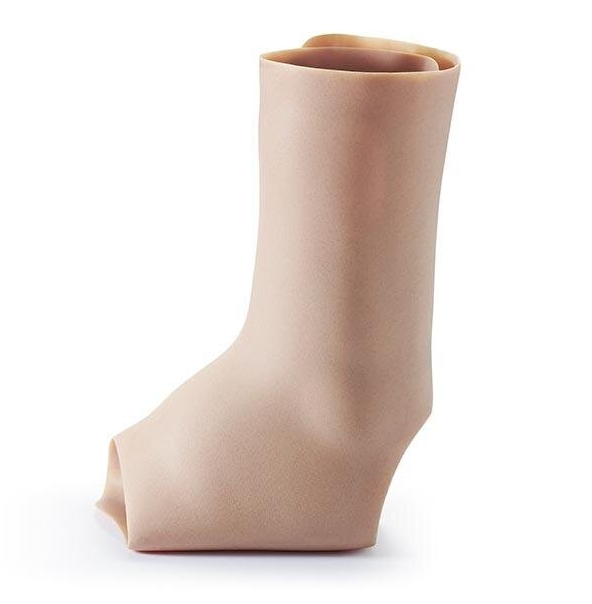
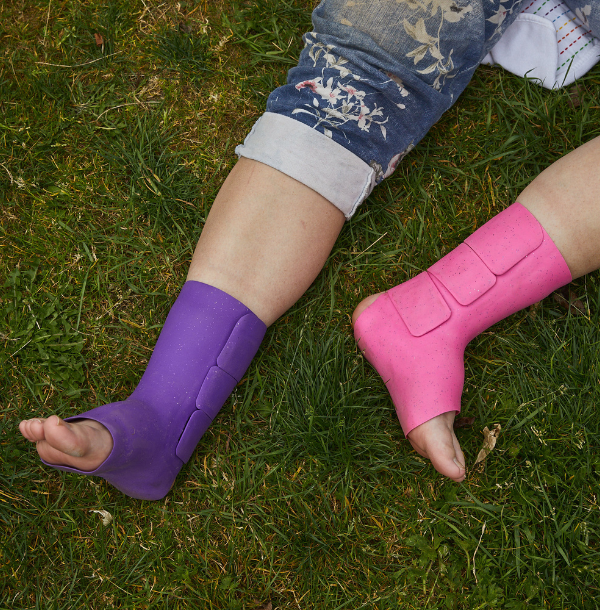
A SAFO is a flexible ankle foot orthosis made from medical grade silicone. It is the most discreet drop foot splints available and can be colour matched to the skin, with up to seven colour options. There are also many funky colours and patterns to choose from. It is typically worn inside the shoe and can also be worn without footwear.
Who is a SAFO - Silicon ankle foot orthosis most suitable for?
Key pros / limitations to a SAFO?
Pros:
✅Soft
✅ Comfortable
✅ Lightweight
✅Allows natural movement
✅ Very discreet
✅ Can be worn without shoes
❌ Unsuitable for individuals with significant ankle instability, ankle deformity, or reduced ankle range of movement.
❌Not suitable for those with significant spasticity
❌ The close-fitting design does not accommodate ankle swelling.
To find out more about SAFO please click here.
Functional Electrical Stimulation (FES) is a wireless device which attaches around the calf. It uses small electrical impulses to activate the nerves and muscles that lift the foot during walking. It helps create a more natural gait pattern and reduces the risk of tripping caused by foot drop.
Who is FES Most Suitable For?
Key Pros / Limitations of FES?
Pros:
✅ Enables a more natural walking pattern
✅ Can improve muscle activation and strength
✅ Reduced bulk and less restriction compared to other splints
✅ Can be used with a wide range of footwear
✅ Adjustable stimulation settings to match individual needs
✅ Lightweight
✅ Can be worn without footwear
Limitations:
❌ Not suitable for complete nerve paralysis
❌ Requires intact skin sensation around the stimulation area
❌ Some users may find initial set-up uncomfortable
❌ May be unsuitable for individuals with significant swelling or spasticity
To learn more about FES please click here
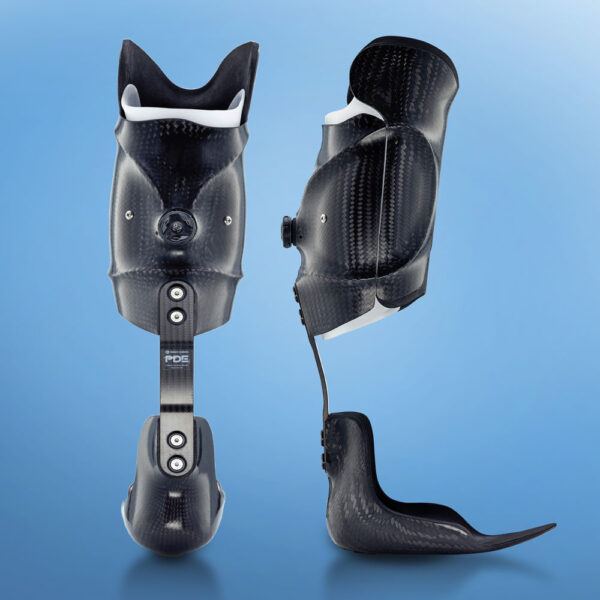
A custom PDE (Posterior Dynamic Element) strut ankle–foot orthosis is a bespoke device designed to provide dynamic dorsiflexion assistance and controlled energy return during walking. The strut is positioned posteriorly and is custom-manufactured to match the individual’s weight, activity level, and biomechanics. It is worn inside the shoe and combined with a custom footplate and calf section. The rear strut can be made in different flexibilities depending on the user's presentation.
Who is the PDE strut AFO most suitable for?
Key pros / limitations to the PDE strut AFO?
Pros:
✅ Custom-tuned energy return
✅ Can also help with ankle plantarflexion (push off) weakness
✅ Durable
Limitations:
❌Limitations on footwear that can accommodate the device.
❌Relatively bulky compared to other devices.
❌Can not be worn without footwear.
❌Limited adjustability in flexibility.
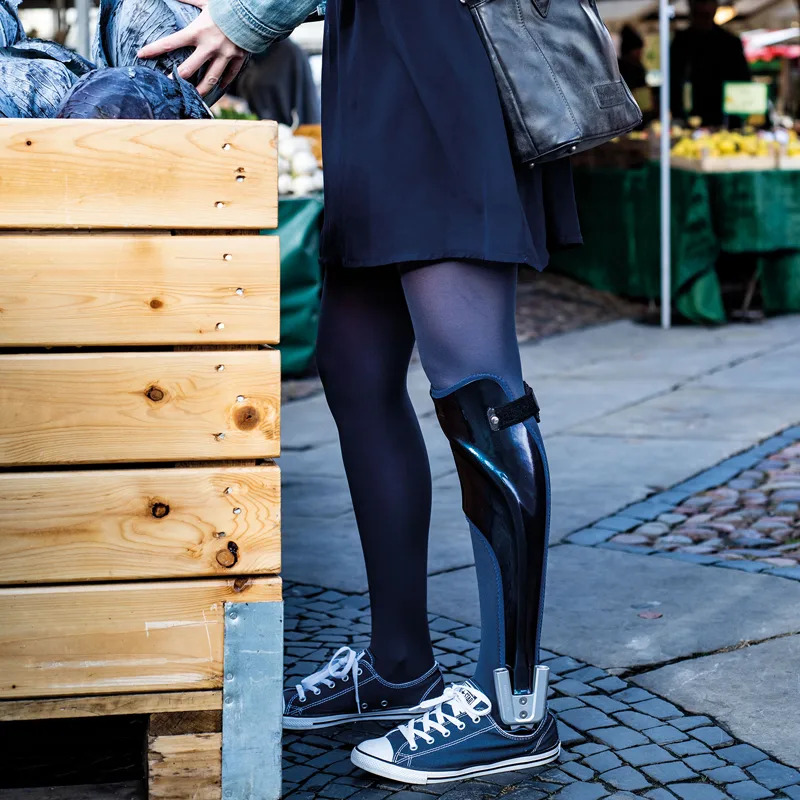
The Neuro Swing AFO is an advanced custom made AFO that has an ankle joint with adjustable springs to fine tune ankle movement and alignment. It provides the clinician with the ability to alter the strength of drop foot assistance in the clinic. If the drop foot improves or becomes more problematic the springs can be altered accordingly
Who is the Neuro-Swing most suitable for?
Key pros / limitations to a Neuro-Swing AFO?
Pros:
✅Provides controlled ankle movement
✅Accommodates complex gait needs
✅ Can be fine-tuned over time.
Limitations:
❌Bulkier than simpler splints
❌Cannot be worn barefoot
❌Increased weight
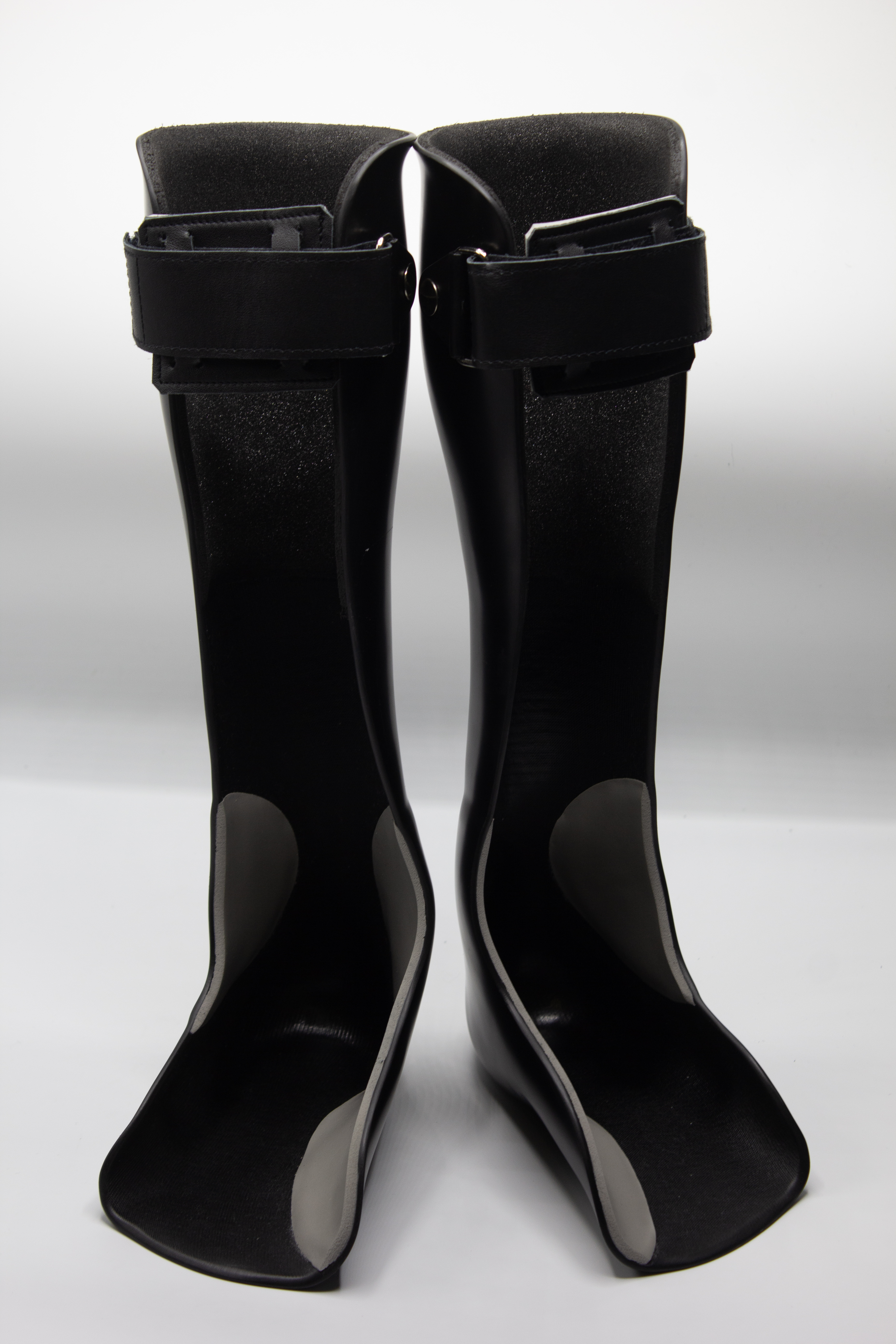
A custom-made AFO is most commonly manufactured from thermoplastic. It is typically produced using either a plaster cast or a 3D scan of the leg to ensure an accurate and individual fit.
Who is a custom-made AFO most suitable for?
Key pros / limitations of a custom-made AFO?
Pros
✅ Gives the clinician greater control over the design, which can improve outcomes.
✅ Provides optimal control in all planes of movement.
✅ Accommodates complex gait patterns and biomechanical needs.
✅ Can be fitted with a rubber sole to allow short-distance walking indoors without footwear.
Limitations:
❌ Bulkier than simpler splints.
❌ Will most likely require specialist orthotic footwear.
To learn more about AFO’s please click here
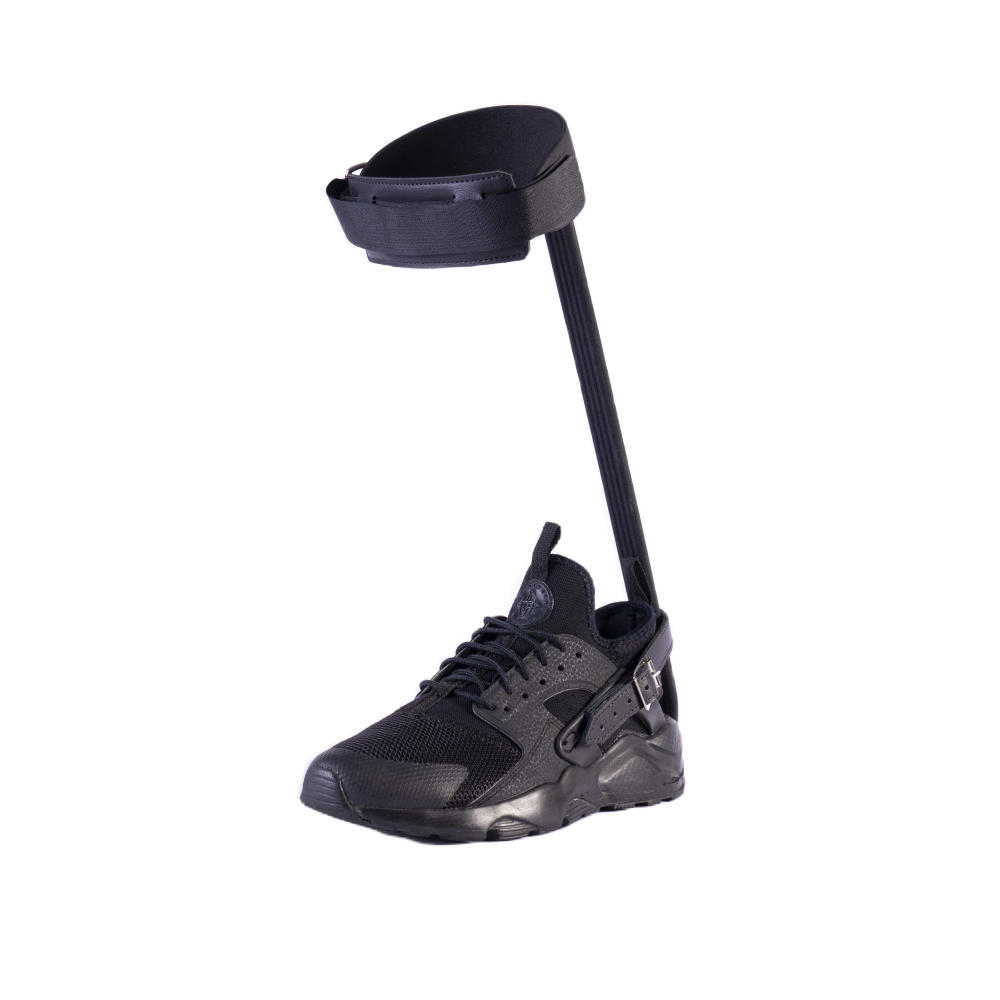
Traditional calipers remain a well-established option in orthotic practice. They consist of metal uprights attached to footwear and are designed to provide robust, long-term support and stability at the ankle. They secure into the footwear via metal sockets.
Who are traditional calipers most suitable for?
Key pros / limitations of traditional calipers?
Pros
✅ Extremely durable and long-lasting.
✅ Fits externally so no brace contact with the skin.
Limitations
❌ Heavier and bulkier than more modern alternatives.
❌ Often requires specialist footwear.
❌ Can be more visible under clothing.
“I hope you have found this list helpful. A thorough clinical assessment, including an understanding of each individual’s personal circumstances and goals, is essential to ensuring drop foot is managed effectively and comfortably.
We have access to a wide range of trial devices, which allows us to assess how each person responds to different options during their clinic appointment and importantly, for the effects to be experienced by the user before they commit to a long-term solution.
It is also worth noting that in the majority of cases there is no single splint that suits every situation, such as sport, smart footwear, home use, or use in bed. As a result, management often involves acceptable compromises or, in some cases, the use of more than one splint for different activities.”
Booking an appointment for a drop foot splint assessment with Orthotics.co.uk is simple. We offer clinics across Manchester, Leeds and Liverpool, and you can choose the location most convenient for you.
1. Book Online
You can book directly through our online booking system and receive a 5% discount.
2. Call our customer service team
If you prefer to speak to someone, our team can help you choose the right appointment on 0330 0883949
3. Email Us
You can also request an appointment by emailing:
Please include:
Our team will respond promptly with available dates.
During your drop foot assessment, one of our HCPC-registered orthotists will:
We offer every type of drop foot splint available on the market.
We assess adults and children diagnosed with:
No GP referral is required.
To get in touch or arrange an appointment, you can call us at 0330 088 3949 or email office@orthotics.co.uk.